
This article explains the Service-Based architecture style, detailing its use of coarse-grained, business-aligned services and explicit contracts. Learn about its benefits, such as improved team autonomy and selective scaling, as well as its trade-offs and practical evolution paths to effectively design and maintain a service-based system.
Definition
Service-based architecture organizes a system around a small number of coarse-grained services aligned to business capabilities. Each service exposes a clear contract and can be developed and deployed independently, while operations remain simpler than those of large microservices fleets. It’s a pragmatic step when a monolith has grown seams and a complete microservices platform would be overkill.
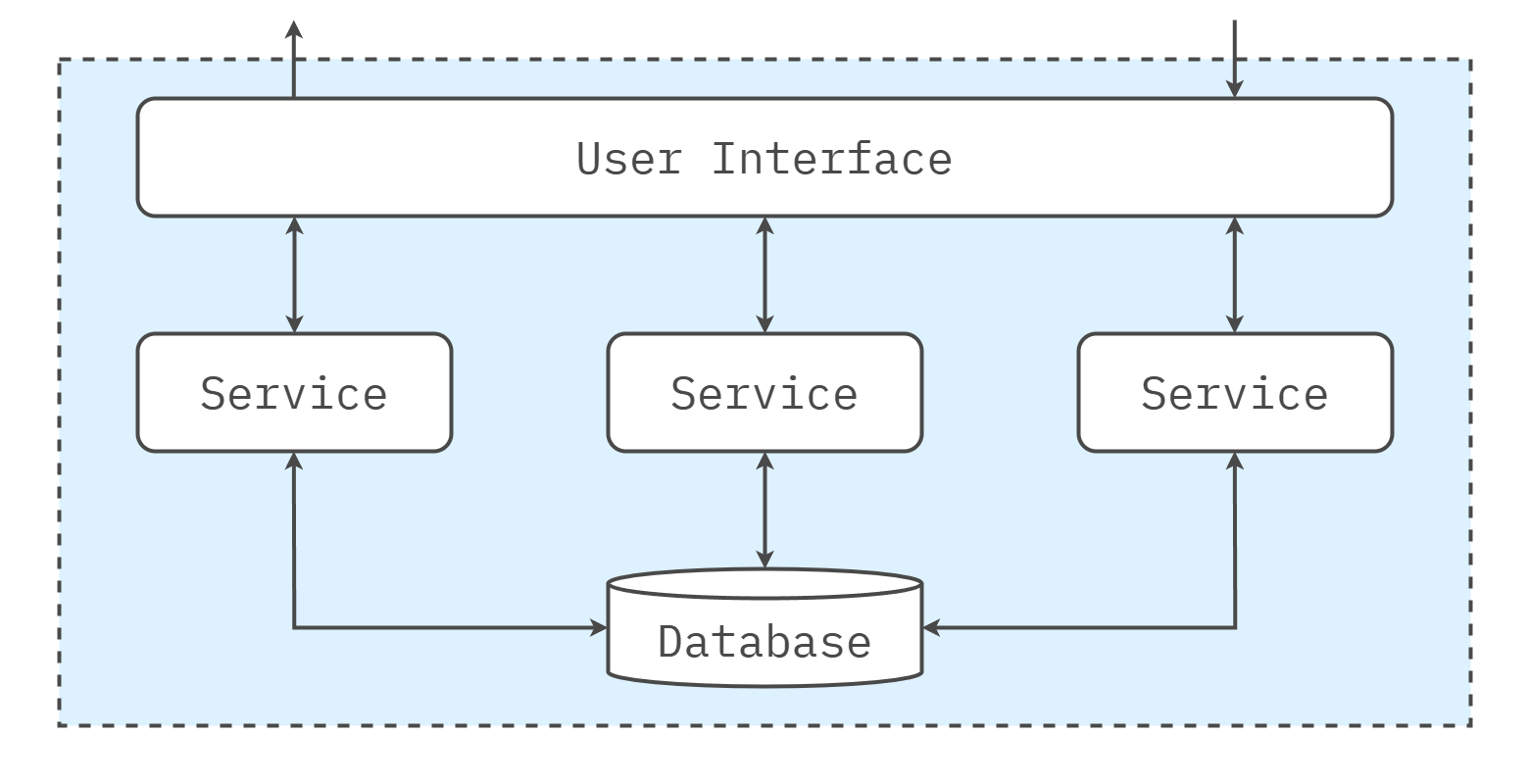
In the service-based style, the system is decomposed into services such as Customer, Order, Catalog, Billing, or Reporting. Services are independently buildable and deployable, expose stable APIs or events, and encapsulate their own logic. Data may be owned per service or shared through a common store; both approaches are used in this style, but the choice has substantial implications for autonomy, transactions, and reporting.
Intent & Forces
The intent is to align software boundaries to recognizable business capabilities, reduce cross-team contention, and unlock selective scaling and deployment. Typical forces include pressure to move faster than a single release train allows, the need for clearer ownership than a large monolith provides, and a desire to avoid the operational weight of dozens or hundreds of microservices. The style favors autonomy at the service boundary and business clarity over maximal independence of every internal function.
Structure
Think in terms of capability slices with explicit edges.
Elements & responsibilities
- Services implement cohesive business capabilities and publish APIs/events that reflect domain language.
- Gateways or edge adapters consolidate external access, authentication, and routing.
- Optional shared utilities remain domain-agnostic to avoid hidden coupling.
Deployment units
- Each service is its own deployable. A small system may start with a handful of services and grow as seams stabilize.
- Teams often own one or more services end-to-end.
Interaction patterns
- Synchronous request/response (HTTP/gRPC) for user-facing paths that need immediacy.
- Asynchronous messaging for workflows, integration, and burst absorption.
Boundaries & contracts
- Stable APIs with versioning and deprecation policy; event contracts use clear schemas and evolution rules.
Failure domains & scaling
- A failure in one service should not take down others; scale hotspots by adding instances only where needed.
Dependency Rules
Services avoid reaching into one another’s internals. Cross-service calls are processed through published contracts; cross-database writes (if a shared database exists) are treated as a last resort and are guarded with clear ownership rules. When a service depends on a peer, prefer coarse-grained calls, timeouts, retries, and circuit breakers; avoid chatty, fine-grained interactions that disguise tight coupling.
Data & Transactions
Two common data choices exist:
- Shared database (pragmatic): services share a schema or database instance with negotiated ownership of tables or views. Pros: simpler reporting and multi-entity queries; easier initial migration from a monolith. Cons: weaker autonomy, coordination during schema changes, and a higher blast radius.
- Database per service (stronger autonomy): each service is the authority for its data. Pros: isolation and independent evolution. Cons: more complex reporting and cross-service consistency.
End-to-end transactions across services are rare; instead, favor local transactions, compensations, and idempotent operations. Utilize outbox patterns and change events to maintain read models in sync and facilitate asynchronous workflows.
Example
An online store exposes three services. Catalog manages products and pricing, Ordering manages carts and orders, and Billing handles payments and invoices. A checkout request is processed by Ordering, which validates items against Catalog (either through a coarse-grained call or a cached read model), reserves inventory, and requests authorization from Billing. On success, Ordering emits an OrderPlaced event; Billing emits PaymentAuthorized; Catalog decrements inventory on OrderPlaced. Each service evolves behind its own API; shared concerns, such as authentication and rate limiting, sit at the gateway.
Design Considerations
Where It Fits / Where It Struggles
Service-based architecture is suitable when a monolith’s boundaries are well-defined. Still, coordination is slowing teams, when selective scaling is needed for a few capabilities, and when operations should remain simpler than a complete microservices platform. It struggles when services require heavy cross-calls on hot paths, when strong consistency across multiple capabilities is non-negotiable, or when team boundaries do not align cleanly with the chosen services. In those cases, strengthen seams or reconsider the scope (merge or split differently) before adding more services.
Trade-offs
- Optimizes: business alignment and ownership, independent deployment of major capabilities, selective scaling, clear fault domains
- Sacrifices: the absolute simplicity of a single artifact, global transactions, and some forms of cross-entity querying
- Requires: stable contracts, basic platform support (service discovery, observability, CI/CD), disciplined data ownership, and evolution
Misconceptions & Anti-Patterns
- “It’s microservices-lite, so rules don’t matter.” Skipping contracts, versioning, and SLOs creates brittle systems.
- Chatty service meshes. Fine-grained calls across services increase latency and failure modes; make calls coarse and purposeful.
- Shared database as a free-for-all. Without table ownership and change process, you re-create the monolith’s coupling at a distance.
- One service per team by default. Start with capabilities; let ownership follow boundaries, not the other way around.
Key Mechanics Done Well
- Identify clear service responsibilities with a ubiquitous language; publish APIs and events that reflect that language.
- Keep edges resilient: timeouts, retries with jitter, circuit breakers, and backpressure.
- Use consumer-driven contract tests for APIs and schema-evolution rules for events.
- Standardize telemetry: trace IDs across calls, service-level SLOs, and golden signals (latency, errors, saturation, traffic).
- Run zero-downtime database and API evolution (expand/contract, additive changes, and deprecation windows).
Combining Styles
Service-based systems often embed layered slices within each service for internal clarity, utilize event-driven integration between services for decoupling, and apply modular-monolith techniques to maintain internal structure within each service. Caching and read models reduce cross-service chatter on user-facing paths; gateways consolidate authN/Z, routing, and rate-limiting.
Evolution Path
Start with a few services that match real seams in behavior and data. As evidence accumulates, you may merge services whose changes are tightly coupled, split a service whose responsibilities diverge, or migrate a capability toward microservices if autonomy and scale demands justify the added operational cost. If a shared database becomes a bottleneck, introduce per-service schemas gradually, supported by events and read models.
Operational Considerations
Treat each service as a product: define SLOs, on-call rotations, and clear ownership. Provide standard tooling—such as service discovery, logging, tracing, and metrics—so teams do not reinvent the platform. Adopt progressive delivery (canaries, traffic splitting) per service. For shared databases, enforce ownership and change review; for per-service databases, invest in data replication, reporting pipelines, and backup/restore drills.
Decision Signals to Revisit the Style
Re-evaluate boundaries when you observe persistent cross-service changes that necessitate coordinated deployments, high-chatty traffic between a pair of services, schema changes that ripple across multiple teams, or difficulty meeting SLOs due to unclear ownership. If service count grows without operational maturity, consider consolidation. If a single service becomes a scalability or risk hotspot, consider splitting or moving it toward a more autonomous deployment.
Recommended Reading
Web Resources
- Developer To Architect, Lesson 114 - Microservices vs Service-Based Architecture
- Developer To Architect, Lesson 163 - Service-Based Architecture
- Developer To Architect, Lesson 153 - Service-Based Architecture vs. SOA
Books
- Richards, M., & Ford, N. (2020). Fundamentals of Software Architecture: An Engineering Approach . O’Reilly Media.
- Chapter 13: Service-Based Architecture Style
Frames service-based as coarse-grained, business-aligned services with pragmatic data choices; contrasts it with microservices and discusses scaling, contracts, and governance.
- Chapter 13: Service-Based Architecture Style