
This article explains the Modular Monolith architecture style, detailing its domain-driven structure, enforceable boundaries, and data ownership principles. Learn about its benefits, such as development speed and maintainability, as well as its trade-offs and practical evolution paths to effectively design and maintain a modular monolithic system.
Definition
A modular monolith is one deployable application split into real modules aligned to the domain. Each module owns its behavior and data, backed by a clear contract. You get the speed and simplicity of a monolith with the order and evolvability of services—without the tax of distributed systems.
A modular monolith organizes a single process around domain modules: cohesive slices that encapsulate capabilities, policies, and the data they authoritatively own. Modules hide their internals and expose contracts—APIs and/or events—written in ubiquitous language. This is not a pre-microservices stage; it is a complete architecture that preserves the option to extract later if the evidence demands it.
Intent & Forces
The intent is to localize changes and reduce coordination by allowing modules to evolve semi-independently within one deployable. The style balances common forces: a need for speed now, the desire to keep an option to split later, and the reality that most teams don’t want to run a distributed platform before they must. It responds to domain volatility by organizing around policies and workflows rather than around tables or technical layers.
Structure
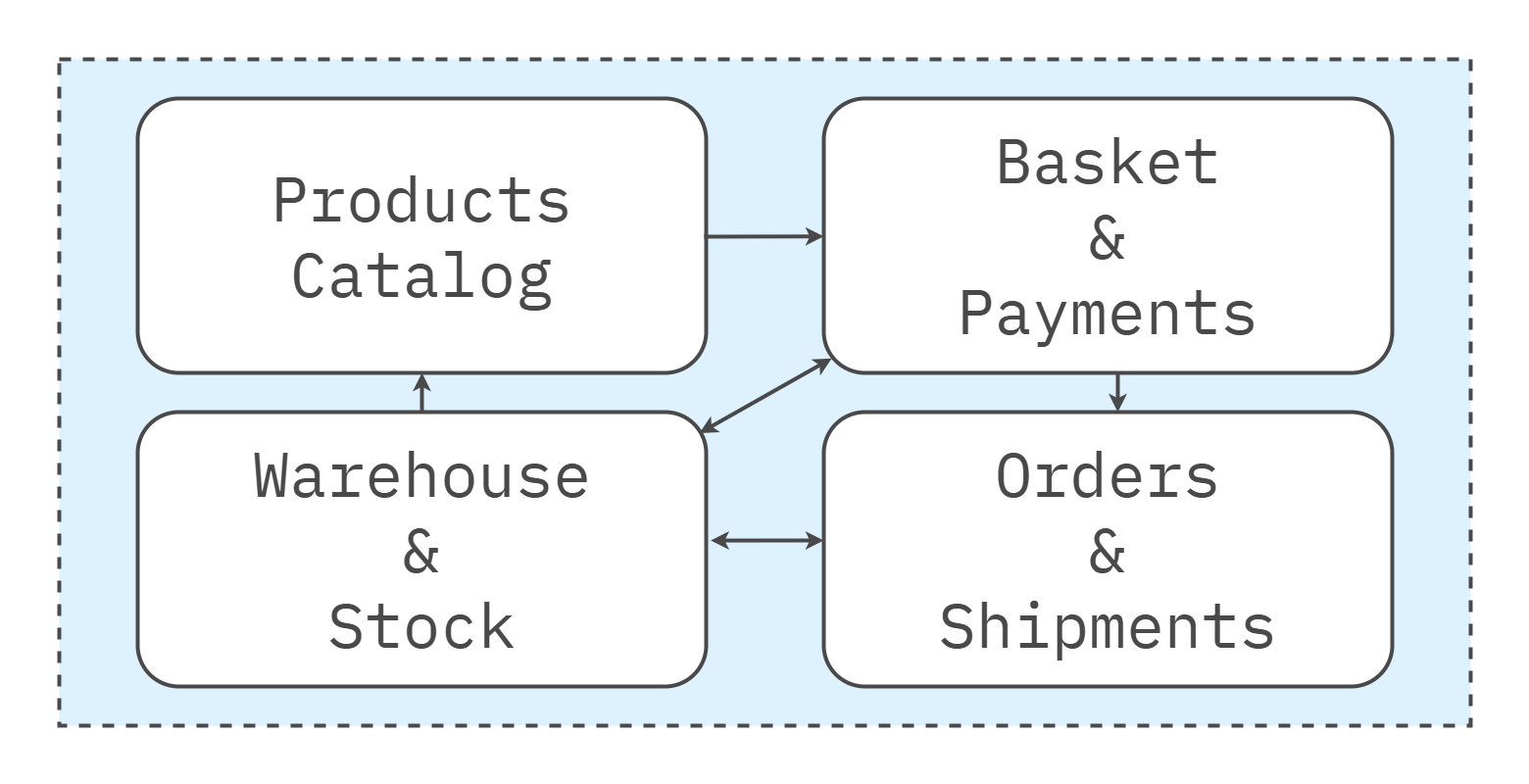
Think in slices, not tiers. Each module typically contains its own thin presentation/API, application/workflow, domain rules, and infrastructure/persistence code. Internals are private; collaboration happens only via the module’s public surface (methods and/or events). Physical deployment remains a single artifact; language access modifiers, namespaces, and automated rules enforce logical boundaries. When coupling grows, prefer publishing events over adding chatty in-process calls across modules.
Dependency Rules
Modules do not reach into each other’s internals. There is no cross-module data write—one writer per dataset. Consumers call a module’s API or subscribe to its events; shared “domain” utilities are treated as a smell and kept domain-free. Enforce rules with architectural tests, including allowed dependency lists, package boundary checks, and cycle detectors, in the CI.
Data & Transactions
A module is the authority for its data and owns its write model. Multiple modules may share a physical database, but not each other’s tables or write models; schema segments map to modules. Transactions are local to a module; cross-module workflows coordinate with events or explicit orchestration through public APIs. Reading models and local caches within a module helps avoid cross-module “N+1” calls.
Example
In an e-commerce system, Ordering processes orders and determines state transitions; Catalog handles product queries; Billing authorizes and settles payments. Ordering does not write to Billing’s tables, and Catalog does not reach into Ordering’s entities. Ordering exposes placeOrder() and emits OrderPlaced; Billing listens to OrderPlaced to charge, then emits PaymentAuthorized; Ordering reacts to update order status. Internals remain hidden; collaboration occurs through contracts and events.
Design Considerations
Where It Fits / Where It Struggles
It suits teams that want fast development, clear ownership, and lower operational overhead compared to microservices—mainly when the domain can be divided into well-understood capabilities with minimal cross-module communication. It struggles when you require strict fault isolation or independent scaling across many modules, or when team boundaries and the module map fundamentally conflict. In those cases, strengthen seams first; extract only where reality (load, risk, or cadence) justifies it.
Trade-offs
- Optimizes: development speed, maintainability, testability, low call overhead, simple transactions
- Sacrifices: independent runtime scaling and hard fault isolation (blast radius is the process)
- Requires: real boundaries (private internals), contract-first collaboration, automated enforcement
Misconceptions & Anti-Patterns
- “Modules are just packages.” A module is a semantic boundary with rules; a package is only mechanical unless enforced.
- “We’ll add microservices later, so anything goes now.” Erosion now makes extraction harder later; guard seams from day one.
- Cross-module DB writes and ad-hoc queries. Always go through APIs/events.
- God utilities that smuggle domain rules. Keep shared utilities domain-agnostic.
- “Misc” or “shared-domain” modules. These become coupling magnets; split by capability.
Key Mechanics Done Well
- Assign every component one home; unclear placement signals a boundary flaw. Ownership implies data authority and an API/event surface.
- Keep internal layering per module (API → domain → infrastructure).
- Add fitness functions in CI: allowed-deps, no cycles, forbidden imports; turn violations into failing builds.
- Prefer additive evolution of contracts and events; document error semantics (idempotency, retries, compensations).
Combining Styles Intentionally
Modular monoliths blend well with event-driven integration at module boundaries and with read-optimized patterns (for example, per-module caches or projections) for hot paths. Use synchronous calls when the SLA is tight and failure coupling is acceptable; use events to decouple and absorb bursts of traffic. Wrap external capabilities (payments, identity, search) behind module adapters to prevent leaks into other modules.
Evolution Path
Start by reinforcing module seams—code, schema, and ownership. Track incoming/outgoing dependencies, and quickly remove cycles. If evidence indicates a genuine hotspot—such as a change in frequency, incident spread, or resource concentration—extract that module behind its existing contract, rather than splitting by technical layer. Treat extraction as an option unlocked by good modularity, not as the plan.
Operational Considerations
Operations are simpler than in distributed styles: one deployable, centralized logging, and straightforward rollbacks. Still, modules need observability: standardize logging/metrics/tracing fields so you can follow flows across seams; publish SLOs per module where it matters. Version events and contracts, deprecate with timelines, and keep a small set of end-to-end tests to prove the wiring across modules.
Decision Signals to Revisit the Style
Re-evaluate boundaries or consider extraction when you observe sustained cross-module changes that necessitate coordination, “just this once” back-edges becoming precedent, incident blast radius crossing module lines, or hot modules that dominate resources and can’t be isolated using in-process techniques. Use lead time, incident spread, and dependency metrics to guide the call.
Recommended Reading
Web Resources
- Developer To Architect, Lesson 159 - Modular Monolith Architecture
Books
- Bain, D., O’Dea, M., & Ford, N. (2024). Head First Software Architecture. O’Reilly Media.
- Chapter 7: Modular Monoliths — Driven by the Domain
Shows how to slice by capability, assign ownership, and design contracts/events that reflect business language. Includes boundary-enforcement patterns and a performance/maintainability/testability lens.
- Chapter 7: Modular Monoliths — Driven by the Domain