
This article explains the Microservices-Based architecture style, detailing its core principles of independently deployable services and data ownership. Learn about its benefits, such as team autonomy and selective scaling, as well as its trade-offs and the essential platform discipline required for successful implementation.
Definition
Microservices-based architecture decomposes a system into independently deployable services that each own a coherent capability and its data. The payoff is team autonomy and selective scale; the price is distributed complexity across networking, data, and operations.
A microservice is a small, self-contained, deployable unit that exposes a contract (APIs/events), owns its persistence, and can be built, released, and operated without coordinating code changes with peers. Boundaries usually follow business capabilities or DDD bounded contexts, not technical layers. The architecture comprises these services, along with the platform that connects, observes, and governs them.
Intent & Forces
The style exists to allow different parts of a product to evolve at various speeds, scale independently, and fail without taking down the entire system. It addresses forces such as heterogeneous workloads, multiple teams working in parallel, and frequent releases. Counterforces include higher operational overhead, non-trivial data consistency, and harder end-to-end debugging.
Structure
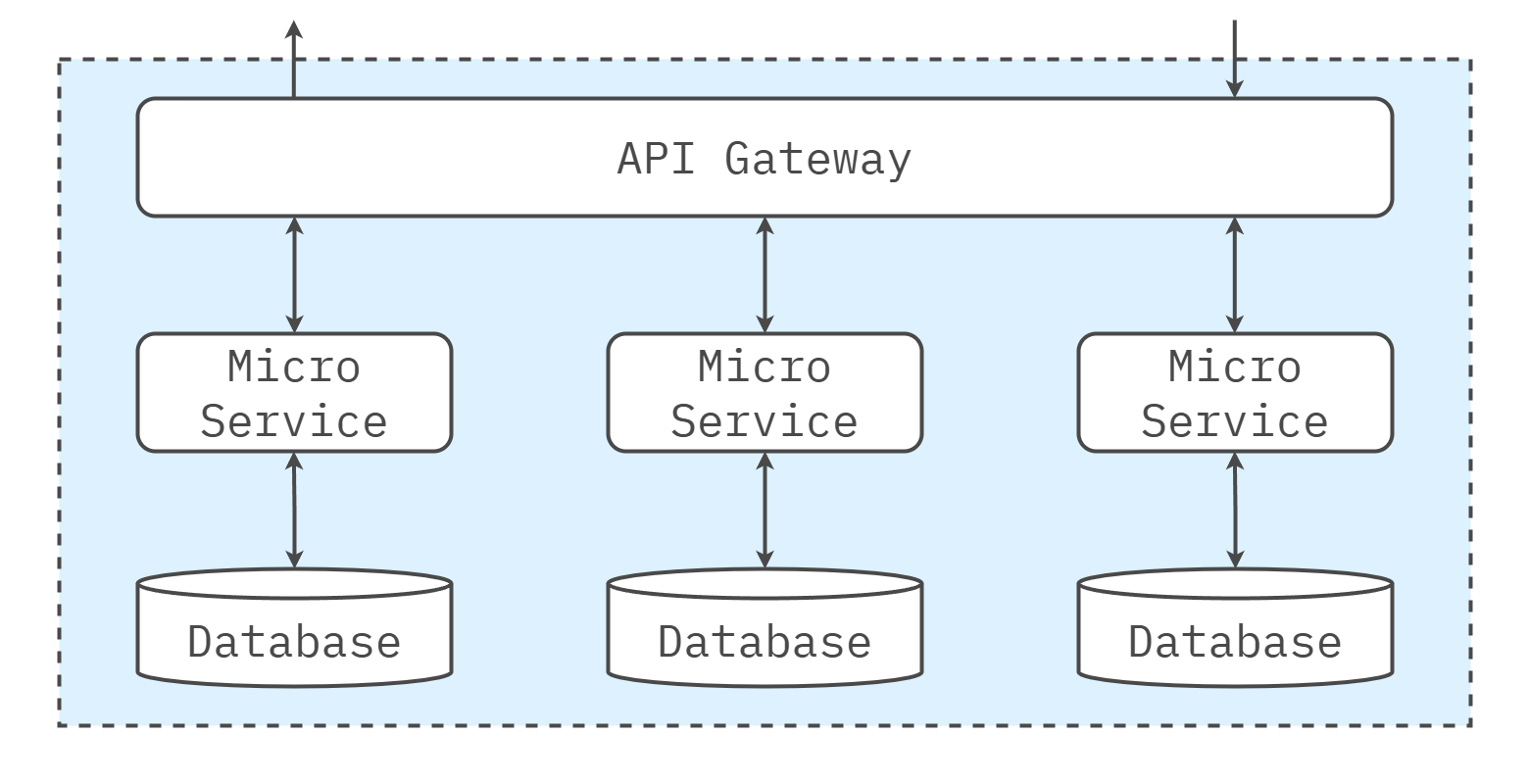
Think in terms of capability slices, each with distinct boundaries.
- Services implement cohesive responsibilities and publish versioned APIs/events.
- Edge/gateway centralizes routing, authN/Z, and rate limits.
- Service discovery/config let services find each other and fetch runtime settings.
- Observability stack (logs, metrics, traces) follows requests across hops.
- Automation (CI/CD, IaC, container orchestration) standardizes build→deploy→operate.
Dependency Rules
Services do not reach into each other’s databases. Integration is through published contracts (HTTP/gRPC/events) with explicit timeouts, retries, and circuit breakers. Avoid chatty, fine-grained RPC across service boundaries; make interactions coarse and purposeful. Shared libraries should be domain-agnostic and versioned deliberately; shared services for genuine platform concerns (identity, billing gateway) are acceptable with clear SLOs.
Data & Transactions
Each service is the single writer for its data. Cross-service workflows favor local ACID plus sagas/compensations over distributed transactions. Use outbox/change events to update read models and keep consumers in sync. Embrace eventual consistency where acceptable; when strong invariants are needed, constrain scope (for example, keep within one service or design a reservation protocol).
Example
In an e-commerce system, Catalog owns product data and pricing; Ordering owns carts and orders; Billing authorizes and settles payments. Checkout calls Ordering, which performs local validation and publishes OrderPlaced. Billing consumes OrderPlaced, authorizes payment, and emits PaymentAuthorized; Ordering reacts to finalize the order. Catalog provides coarse read models to reduce hot-path cross-calls. Each service deploys and scales independently, sharing no write models.
Design Considerations
Where It Fits / Where It Struggles
It suits products with multiple teams and capabilities that evolve at varying cadences, where autonomy, fault isolation, and selective scaling are crucial. It struggles when the domain requires broad, synchronous, and strongly consistent operations, or when platform automation and observability are immature. In such cases, a modular or layered monolith is safer until the organization is ready.
Trade-offs
- Optimizes: team autonomy, independent deployability, fault isolation, selective scaling
- Sacrifices: simplicity of in-process calls, global transactions, easy debugging, and testing
- Requires: strong platform automation, contract governance, observability, and disciplined data ownership
Misconceptions & Anti-Patterns
- “Micro = tiny.” Size isn’t the goal; independent change is.
- Shared database across services. Violates ownership and couples’ releases.
- Distributed layers. Splitting by UI/logic/data across services re-creates a distributed monolith.
- God services and chatty meshes. Coalesce hotspots or redesign contracts; keep hops coarse.
- “We’ll fix ops later.” The platform is part of the architecture—underinvesting dooms the style.
Key Mechanics Done Well
- Boundaries follow capabilities and reasons to change; data ownership is explicit.
- Interfaces are backward compatible and versioned; use consumer-driven contract tests.
- Sync where a user waits; async for workflows and burst absorption—both observable end-to-end.
- Sagas/compensations are designed with idempotency, DLQs, and correlation IDs.
- Platform/SRE: standardized pipelines, golden runtime baselines, unified telemetry, and budgeted error/latency SLOs.
Combining Styles
Most microservice systems embed layered slices within each service for clarity, utilize event-driven integration between services, and adopt orchestration for spans that require ordering and auditability, while leaving the rest choreographed. Hot read paths frequently employ read models or API composition to avoid N+1 calls.
Evolution Path
Start by identifying a few key capabilities with clear boundaries and owned data. As evidence accumulates, merge services that co-deploy or chat heavily; split services that become hotspots in scale or undergo significant changes. Gradually move from shared to per-service schemas with outbox events and backfills. Treat service count as a cost; only add services when autonomy or risk reduction justifies them.
Operational Considerations
Treat each service as a product with SLOs, runbooks, and on-call. Automate deployment (blue/green, canary), config, and secrets. Observe end-to-end: trace IDs across hops, standard logs, and RED/USE metrics per service. Resilience patterns—timeouts, retries with jitter, bulkheads, circuit breakers—are table stakes. Test at multiple layers: contracts, components, and end-to-end journey. Budget and monitor the cost per service.
Decision Signals to Revisit the Style
Re-evaluate boundaries when you see coordinated deploys across “independent” services, persistent chatty traffic between a pair (orchestration suggests fusion), incident blast radii that cross services, or platform toil outpacing feature work. If the majority of requests are synchronous and strongly consistent across many capabilities, consider consolidation toward a modular monolith until conditions change.
Recommended Reading
Web Resources
- Developer To Architect, Lesson 162 - Microservices Architecture
- Developer To Architect, Microservices Lessons
Books
- Richards, M., & Ford, N. (2020). Fundamentals of Software Architecture: An Engineering Approach . O’Reilly Media.
- Chapter 17: Microservices Architecture
Frames microservices as independently deployable capability slices with owned data, and walks through platform needs, contracts, data consistency, and trade-offs.
- Chapter 17: Microservices Architecture
- Richards, M. (2024). Software Architecture Patterns (2nd ed.). O’Reilly Media.
- Chapter 6: Microservices Architecture
Explains topology (edge, discovery, observability), contrasts sync vs. async integration, and warns against shared databases and distributed layers.
- Chapter 6: Microservices Architecture
- Bain, D., O’Dea, M., & Ford, N. (2024). Head First Software Architecture. O’Reilly Media.
- Chapter 10: Microservices Architecture — Bit by Bit
Uses a concrete monitoring domain to show boundary finding, service sizing, orchestration vs. choreography, and resilience patterns in practice.
- Chapter 10: Microservices Architecture — Bit by Bit
- Newman, S. (2021). Building Microservices (2nd ed.). O’Reilly Media.
- Pragmatic guidance on service boundaries, team ownership, testing strategies, contract evolution, and organizational alignment across the lifecycle.
- Nadareishvili, I., Mitra, R., McLarty, M., & Amundsen, M. (2016). Microservice Architecture. O’Reilly Media.
- Organizational alignment, Conway’s Law in practice, API design and governance, and migration patterns from monoliths to microservices at scale.